
Every home has a junk drawer. Most of them are exactly the same: a layer of takeout menus from 2019, three dead batteries, a phone charger for a phone that no longer exists, seventeen pens, and something you cannot identify but feel certain you might need someday. It is not a junk drawer because you are disorganized. It's a junk drawer because that's what happens when a drawer has no job.
Give it a job. That's the whole edit, not a bigger drawer, not a different drawer, just a clear answer to the question "what is this drawer actually for" that you can hold yourself to once the lid closes again.
This post contains affiliate links. As an Amazon Associate, I earn from qualifying purchases, at no extra cost to you. #ad
Everything Out First
The only way to organize a junk drawer is to empty it completely. Not sort through it in place: take everything out, put it on the counter, and look at what you actually have. This usually takes five minutes and is always worse than you expect.
Wipe the drawer. Start fresh. You can't see what you have until it's all in front of you, and you can't make good decisions about what to keep when you're pulling things out one at a time.
The junk drawer becomes junk when the drawer has no job. Give it one.
The Three-Pile Sort
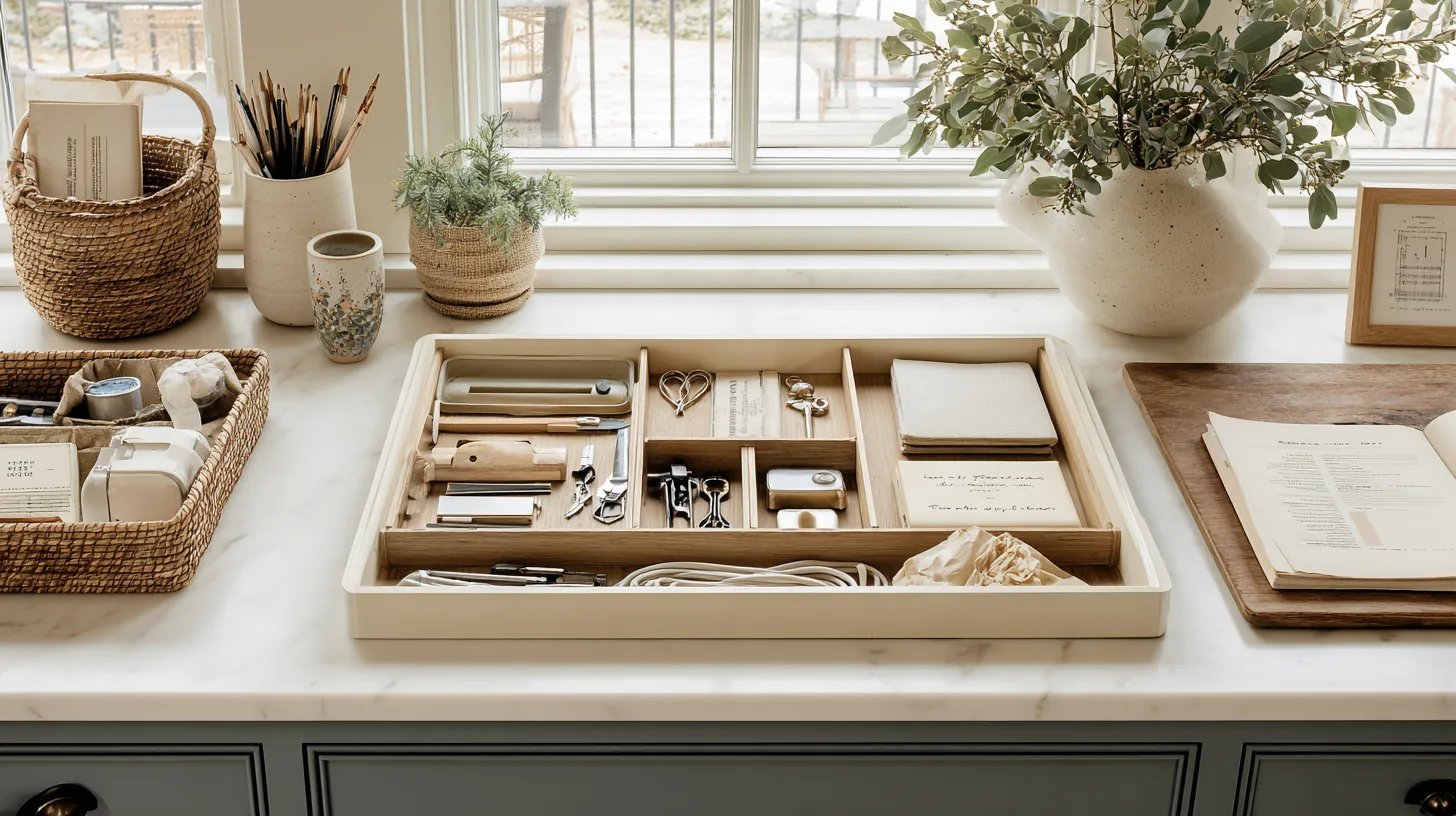
Sort everything into three piles: keep in this drawer, relocate to somewhere else in the house, and toss. Work quickly. If you pause too long on an item you're trying to decide on, it is almost always a toss.
Toss without guilt: dead batteries, old takeout menus, expired coupons, broken anything, duplicate items you don't need two of, chargers without a device, mystery items you can't identify after ten seconds. If you don't know what it is, you don't need it.
Relocate: anything that belongs in a specific room or has a better home elsewhere. Tools go with tools. Tape and scissors might belong at a desk. Medicines belong in a medicine cabinet. The junk drawer should not be the default home for everything that doesn't have a place, that's how it became junk in the first place.
Keep: a small flashlight, a handful of batteries (live ones, tested), scissors, tape, a few pens that work, a notepad, the landlord's number, spare keys. A drawer that holds only these things is doing its job.
The relocate pile is usually the one people rush through, and it's worth slowing down for. A screwdriver that's been living in the junk drawer for two years isn't there because it belongs there, it's there because at some point putting it away properly felt like more effort than it was worth, and nobody's circled back since. Giving it five extra minutes now to actually walk it to the toolbox is what keeps the relocate pile from becoming next year's junk drawer all over again.
The Right Organizer Makes It Hold
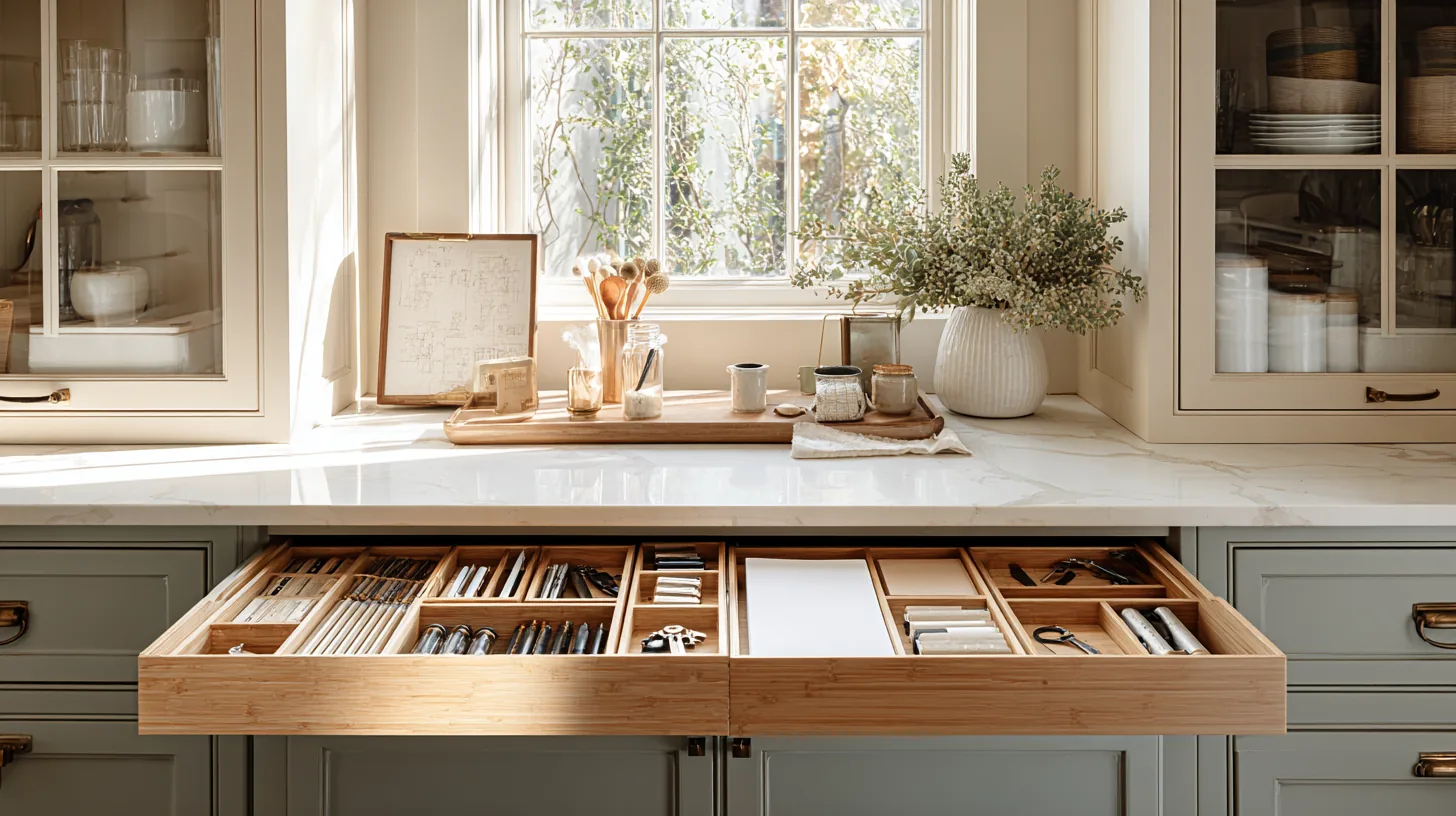
The difference between a drawer that stays organized and one that becomes junk again in two weeks is a divider. Without defined sections, everything migrates to the middle and the system collapses. With them, everything has one place to return to.
A bamboo drawer organizer with adjustable sections is the most practical choice: it fits most drawer sizes, it doesn't slide around, and it looks good even when the drawer is open. Assign one section per category: batteries, writing tools, tape and scissors, small tools, a notepad. That's it. The drawer is full when those sections are full: anything beyond that belongs somewhere else.
Resist the urge to fill every section. Empty space in a drawer is not wasted, it's buffer. It's what absorbs the inevitable small additions before they become a problem.
Bamboo holds up better than it sounds like it should, it wipes clean, doesn't warp from the occasional damp hand, and doesn't look cheap when the drawer is open, which it will be, in front of guests, at some point. A coordinating plastic set works too if that's what you already have; the material matters less than the fact that the sections exist at all. Measure the drawer before you buy anything. An organizer that's a half-inch too wide will tilt, jam, and eventually get shoved to the back of a cabinet: exactly the kind of "I'll deal with it later" that started this whole problem. For more of what earns a spot in a working kitchen, our Kitchen Finds collection is a good place to start.
The One Rule That Keeps It That Way
Once the drawer has a system, one rule maintains it: if something doesn't belong in one of the defined sections, it doesn't go in the drawer. Full stop. Not "just for now." Not "I'll move it later." It finds its actual home immediately, or it gets tossed.
This feels strict until you remember that "just for now" is how the drawer became a junk drawer to begin with. The drawer has a job. Everything in it earns its place. Anything that doesn't earn its place is someone else's problem, which means a different drawer, a different room, or the trash.
It helps to say this rule out loud once, to whoever else opens the drawer. A system only one person knows about isn't really a system, it's a chore that resets every time someone else uses the drawer without knowing the categories exist.
The Two-Minute Monthly Check
A drawer with a good system can still drift. Mail gets opened over the counter and a stray receipt lands in the drawer instead of the recycling. A spare battery from a gift gets tossed in because no one wanted to find its real home in the moment. None of this is a failure of the system, it's just what happens in a house people actually live in.
The fix isn't another deep clean. It's two minutes, once a month, standing in front of the open drawer and just looking at it. Not reorganizing. Not emptying. Looking. Anything that clearly wandered in and doesn't belong gets moved to its real home right then, while it's still one or two items and not a re-sort.
The other half of the habit happens in the moment, not on a schedule: when something doesn't have an obvious home and the drawer is right there, pause for ten seconds and ask whether it actually belongs somewhere else first. If the answer is yes, and it almost always is, take it there now instead of "for now." A junk drawer that holds doesn't stay organized because no one ever drifts. It stays organized because drift gets caught early, in two minutes, before it becomes a project again.
The whole edit takes less than an hour. The result is a drawer that works every time you open it, not one you have to sort through to find a pen.